Take this week alone. A science-and-technology outlet — the kind of site that usually covers satellites, dinosaur footprints and Alzheimer’s research — published a piece on how to spot whether a Champagne’s price tag is actually justified. Vineyard selection, ripeness at harvest, the mastery of blending across vintages, the patience of lees ageing: all the usual suspects, explained for a general audience with no particular wine expertise.
Four months earlier, a French Champagne retailer had published almost the same article. Different angle — theirs was about tasting rather than making: the finesse of the bubbles, the aromas of brioche and hazelnut, what the letters “RM” mean on a label. But strip away the framing and both pieces are answering the exact same question: how do you know if a bottle of Champagne is worth what you’re paying for it?
Neither copied the other. That’s the interesting part. Two publications with nothing in common — one explains photosynthesis and asteroid impacts for a living, the other sells Champagne directly to consumers — arrived at the same topic, a few months apart, because it’s simply in the air. It’s the kind of story that gets written over and over because it always performs, always feels timely, and requires no actual news.
Meanwhile, on the other side of the world, there was actual news — and it moved through far fewer feeds.
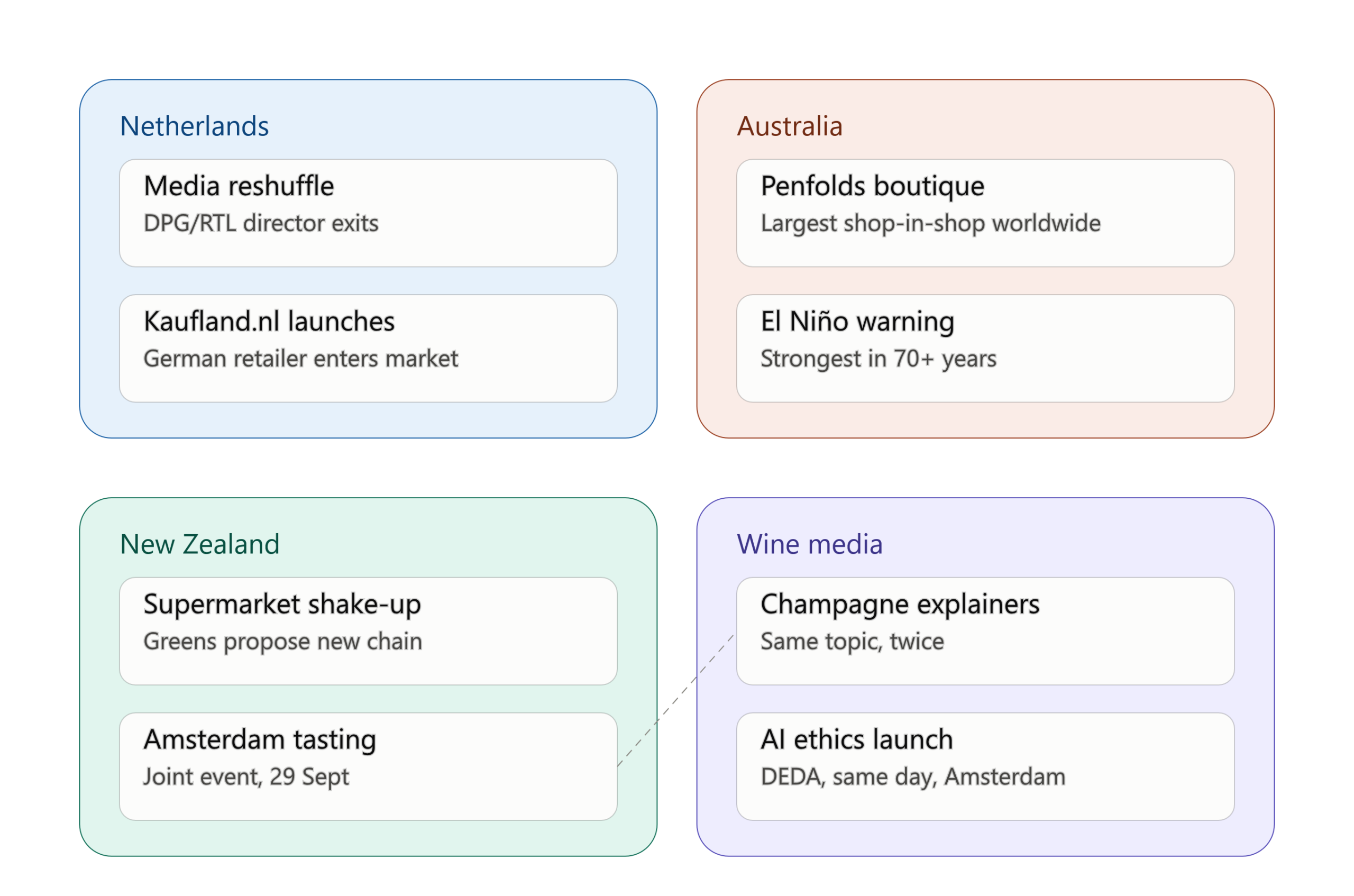
Penfolds just opened its largest shop-in-shop boutique anywhere in the world, a 44.6-square-metre space in Sydney Airport’s Terminal 1, and the first to carry the brand’s new global concept design. It’s a genuinely significant piece of travel-retail strategy: dedicated zones for each of Penfolds’ four countries of origin, a rotating feature area for launches and seasonal campaigns, and — in the “you can’t buy this anywhere else” category — two of only twenty bottles worldwide of the Bin 389 Designed by Troye Sivan magnum. Heinemann Oceania and Sydney Airport were there for the ribbon-cutting. It’s a real story about how a heritage Australian brand is investing in the traveller as a customer segment. And it will likely get a fraction of the attention that a listicle about Champagne bubbles gets, because openings and installations are harder to package as content than “5 signs your Champagne is overpriced.”
And underneath both of these — the recycled explainer and the retail opening — sits a story that deserves far more ink than it’s getting: Australia’s Bureau of Meteorology has warned that an El Niño now forming in the tropical Pacific could become one of the strongest in more than seventy years, peaking in the second half of 2026. For Australian growers, this arrives on top of an already brutal 2026 vintage — frost, fire and flood damage across regions from Tumbarumba to the Riverina, where thousands of hectares have simply been pulled out. New Zealand, by contrast, is reporting excellent fruit quality from its 2026 harvest, even as forecasters flag the possibility of a “super El Niño” hitting its summer of 2026–27. Two countries, one climate pattern, two very different vintages — and comparatively little coverage connecting the dots, especially compared to how quickly a Champagne-price explainer travels.
This is roughly the state of wine media right now: an oversupply of easy, evergreen, recyclable content sitting right alongside real stories — a flagship retail opening, a climate pattern reshaping entire harvests — that require someone to actually go looking.
And it isn’t just wine. The same week all of this landed in my feeds, Peter van der Vorst — content and strategy director across RTL and DPG Media’s channels in the Netherlands and Belgium — announced he’s leaving after seven years for “a new chapter,” right in the middle of DPG’s post-merger reorganisation of the Dutch media landscape. On the other side of the world, New Zealand’s Green Party unveiled a plan to break up the country’s supermarket duopoly with a new state-backed grocery chain, aimed squarely at bringing down food prices. And right here at home, Kaufland — the German retail giant from the same group as Lidl — just launched Kaufland.nl, its first foothold in the Dutch market, positioning itself as a European answer to Amazon and eBay. Different countries, different industries, same underlying story: incumbents reshuffling or facing new competition, all in the same seven-day window I happened to be reading about Champagne bubbles.
Layered on top of that is the industry’s own attempt to make sense of what artificial intelligence is doing to all of it. DPG Media and Utrecht University have spent the past year building DEDA for Media — an “ethical compass” for newsrooms and data teams navigating AI projects — and they’re launching it publicly on 29 September in Amsterdam. That happens to be the exact same day, in the exact same city, as the Wine Australia and New Zealand Winegrowers trade tasting.
That’s really the throughline here. Champagne explainers duplicating themselves across sites with nothing in common. A media empire reshuffling its leadership while a government party proposes breaking up a grocery monopoly on the other side of the planet. An AI ethics launch and a wine tasting sharing a calendar date by pure coincidence. None of it is connected — and that’s exactly the point. There’s simply too much happening, in too many places, for anyone to keep track of all of it at once, wine included.
I’ll admit I’m not entirely neutral on this. On the Dutch side of what I do, I’ve watched names and formats surface over the years that sit a little too close to Wijnplein for comfort. I’ve never made a fuss about it. Once something works, it was always going to get copied — that’s just what attention does in a crowded market. You can either spend your energy chasing every imitator, or you can keep building the thing people came to you for in the first place. I know which one I’d rather do.
Which is partly why I’m glad the next couple of weeks bring something closer to home. On 29 September, Wine Australia and New Zealand Winegrowers are bringing their joint trade tasting to Amsterdam, part of a European roadshow that also stops in Antwerp and Warsaw. It’s a fitting coincidence: the same two countries currently bracing for a strong El Niño will be pouring their wines a short train ride from where I’m writing this.