
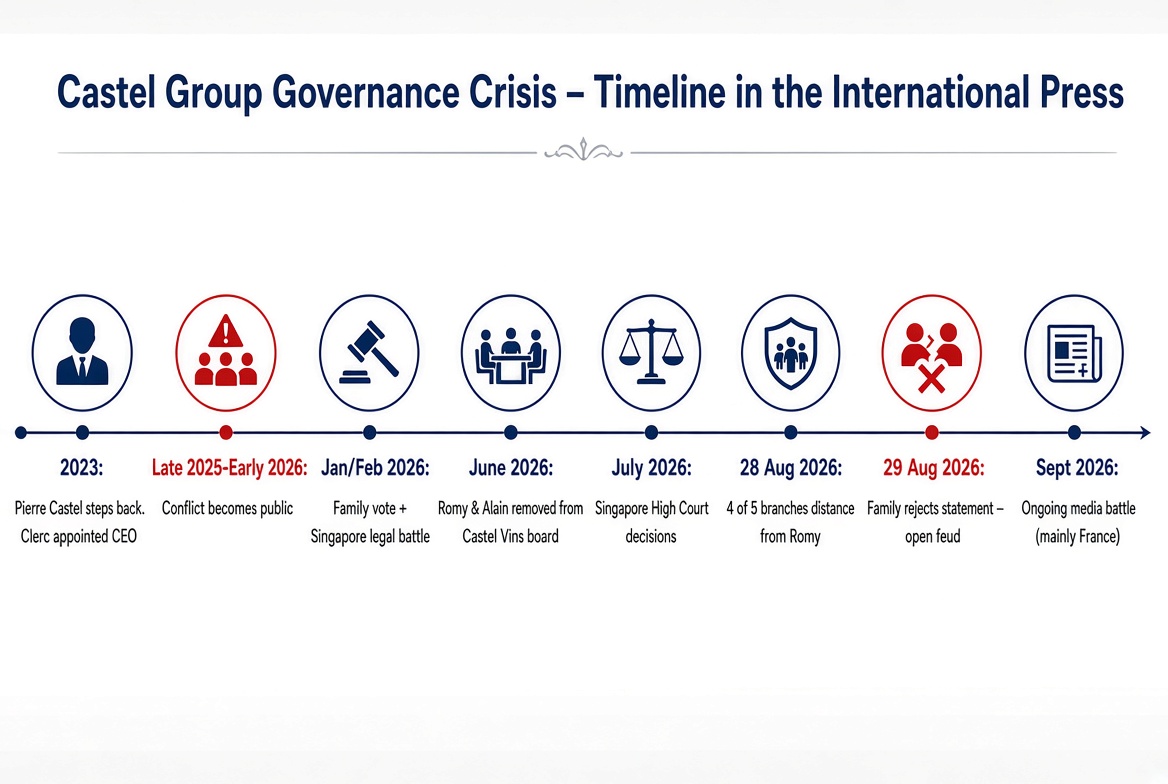
The Castel Group, one of Europe’s largest wine operators and a major player in beer and soft drinks across Africa, has been facing a serious governance crisis for several months. What started as an internal conflict has turned into an open family dispute, complete with public statements, legal battles, and growing media attention — especially in France.
A Governance Conflict, Not an Operational One
At the centre of the dispute are Romy Castel (daughter of the 99-year-old founder Pierre Castel) and her cousin Alain Castel, who are locked in a struggle with current CEO Gregory Clerc, a Swiss tax lawyer appointed in 2023. The family accuses Clerc of concentrating too much power and moving away from the founder’s original vision. Clerc and part of the management maintain that they are simply protecting the trust and holding structure that Pierre Castel himself put in place to separate family ownership from professional management.
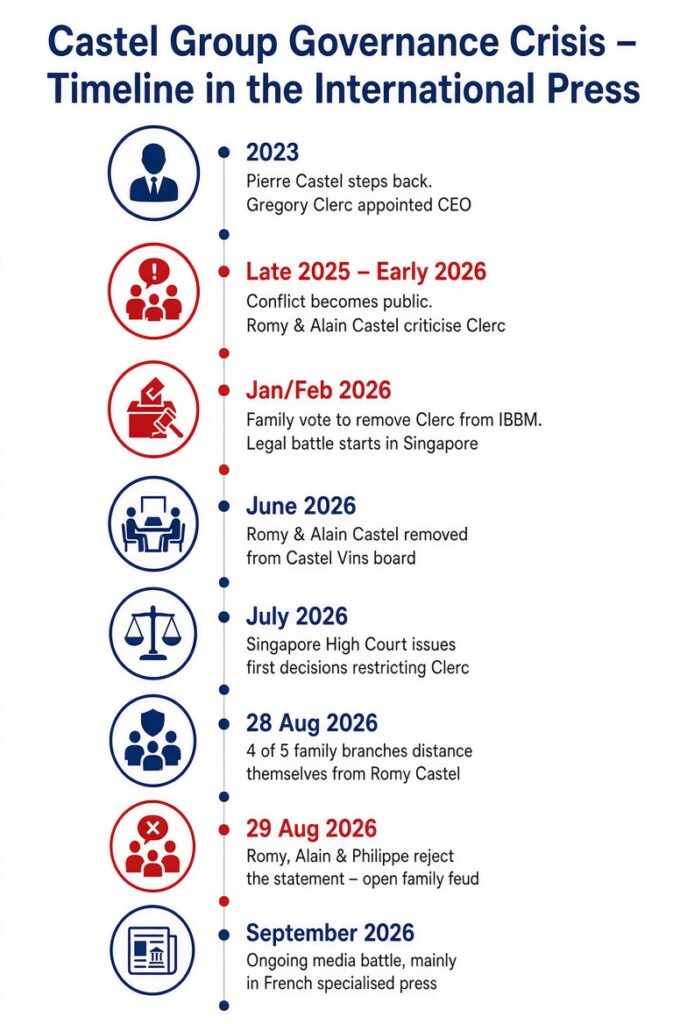
In recent weeks the conflict has escalated. At the end of August, a press release claimed that four of the five family branches were distancing themselves from Romy Castel and supporting the continuity of the current leadership. Romy, together with Alain and Philippe Castel, immediately rejected the statement, questioning its legitimacy and reaffirming their position.
The battle is mainly being fought in the courts of Singapore (home to the top holding company IBBM), with additional fronts in Geneva and Luxembourg. Meanwhile, Romy and Alain were already removed in June 2026 from their board seats at Castel Vins, the group’s historic wine division.
A French Affair… For Now
So far, the media noise remains largely concentrated in France. Specialised outlets such as Vitisphere, Sud Ouest and Challenges are covering the case in detail, while coverage in other European markets is much more limited. This is essentially a governance and control dispute over the group’s upper corporate structures, rather than an immediate operational problem in the commercial subsidiaries.
What Does This Mean for the Netherlands?
In the Netherlands, Castel is present through LFE (Groupe L.F.E. B.V.), one of the country’s leading wine importers and wholesalers, based in Maartensdijk. LFE is a 100% subsidiary of Castel Frères and operates with a high degree of autonomy.
For the time being, there are no visible changes in LFE’s day-to-day operations. The conflict is taking place at the higher levels of the group and has not, at least publicly, affected the commercial management of the European subsidiaries. However, in a group of this size, a prolonged power struggle can eventually lead to reorganisations, strategic shifts or even structural changes.
Specialised platforms such as Flying Wine Writer and Wijnplein.nl, which closely follow developments in the Dutch and European wine sector, are watching how this crisis unfolds. For now, the impact on the Dutch market remains limited, but it cannot be ruled out that a prolonged conflict — or a major restructuring of the wine division — could eventually have consequences for LFE as well.
Conclusion
The Castel Group crisis is first and foremost a family governance and corporate control issue that is generating significant media attention in France. For the Dutch market and for LFE, it remains a distant conflict at this stage. It remains to be seen whether, over time, this dispute will translate into concrete changes within the group.